
We only get one life. One chance to seek truth, to live with integrity, and to make the most of our time. If that’s the case, then shouldn’t we be absolutely certain that what we dedicate our lives to is actually real?
Yet, when it comes to religion, most people don’t apply the same scrutiny they would to anything else. They believe what they were raised to believe, not because they examined all possibilities and found it to be true, but because it was handed to them as truth from birth.
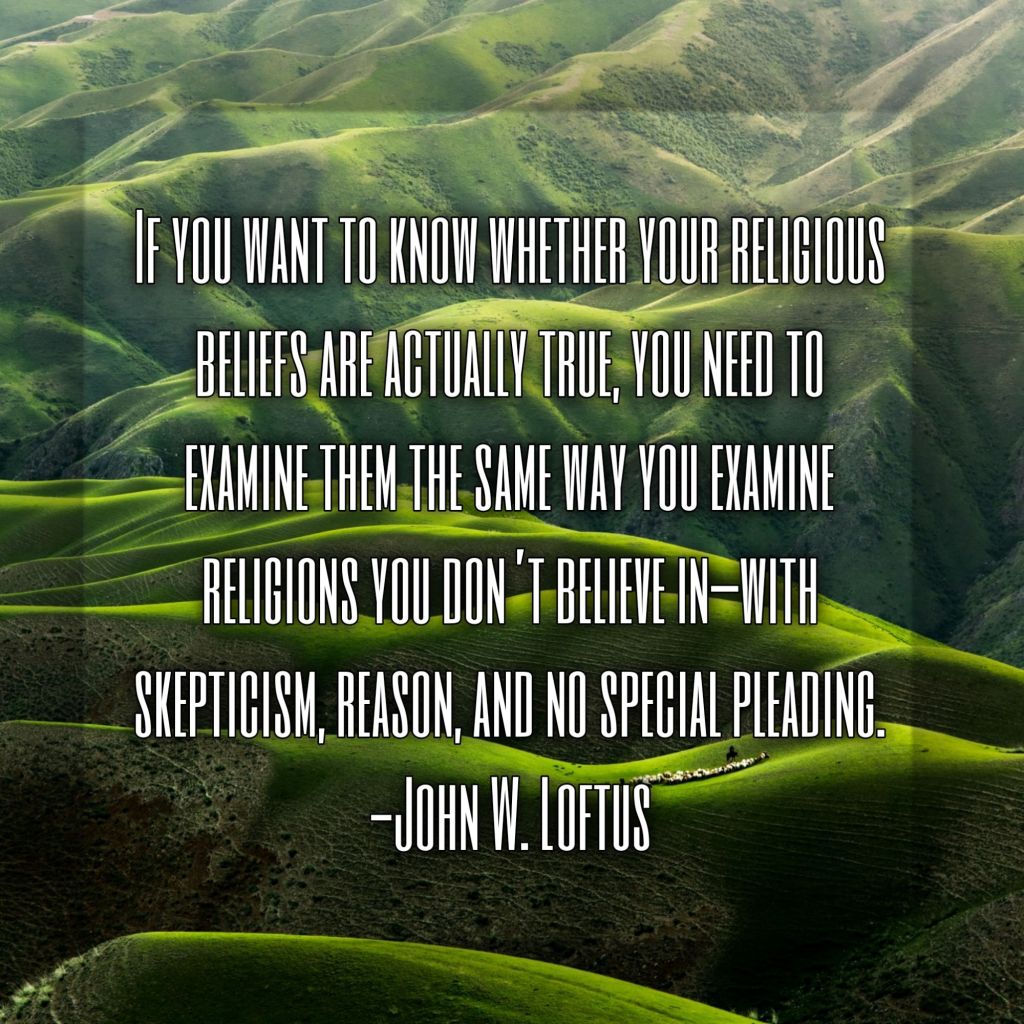
Christopher Hitchens pointed out a crucial flaw in religious thinking: the so-called “evidence” believers use to justify their faith is self-interested—it assumes the conclusion before the argument even begins. John W. Loftus expands on this with what he calls The Outsider Test for Faith: If you want to know whether your religious beliefs are actually true, you need to examine them the same way you examine religions you don’t believe in—with skepticism, reason, and no special pleading.
Think about it. Christians dismiss Hinduism, Islam, and Norse mythology without a second thought. Why? Because those beliefs seem absurd to them. But have they ever applied that same reasoning to their own faith? Wouldn’t it be dishonest not to?
If a Muslim tells you the Quran is the word of God because the Quran says so, do you accept that? If a Hindu tells you Krishna is real because they “feel his presence,” does that convince you? No. And yet, Christians, Jews, and Muslims use these very same arguments to justify their own faith.
Why is this test important? Because if truth matters, then how we arrive at our beliefs matters. If a belief can’t withstand the same scrutiny you use to dismiss other religions, why should you keep believing it?
The fact is, there is no verifiable evidence for any god. People claim to have “personal experiences,” but so do followers of every religion. Holy books claim divine authority, but so do countless other scriptures. Miracles are “witnessed,” but never in a way that can be objectively proven. If you had been born into another culture, you would believe just as strongly in a different god. Doesn’t that tell you something?
This is the only life we know we have. Should we really waste it following beliefs we can’t even verify? Or should we have the courage to test them honestly, to demand evidence that holds up under scrutiny, and to reject ideas that fail to meet that standard?
Ask yourself: If my religion is true, shouldn’t it pass The Outsider Test? If I’m honest with myself, do I apply the same skepticism to my beliefs as I do to others? If not—why?
Your beliefs should be able to withstand the same level of scrutiny you apply to every other religion. If they can’t, maybe it’s time to ask yourself what you’re really holding onto—and why.

Sources
Loftus, J. W. (2013). The outsider test for faith: How to know which religion is true. Prometheus Books. Retrieved from https://www.amazon.com/Outsider-Test-Faith-Skeptical-Religion/dp/1616147375
Hitchens, C. (2009). God is not great: How religion poisons everything. Twelve. Retrieved from https://www.amazon.com/God-Not-Great-Religion-Everything/dp/0446697966
Internet Infidels. (n.d.). The secular web: A collection of critical religious analyses. Retrieved from https://infidels.org/
 Logical Exodus