
Throughout history, religious figures have been revered as divinely inspired messengers. But if we take a step back and look critically at the behavior of some of God’s prophets, a different picture begins to emerge—one that might make us question what we consider divine wisdom versus mental instability.
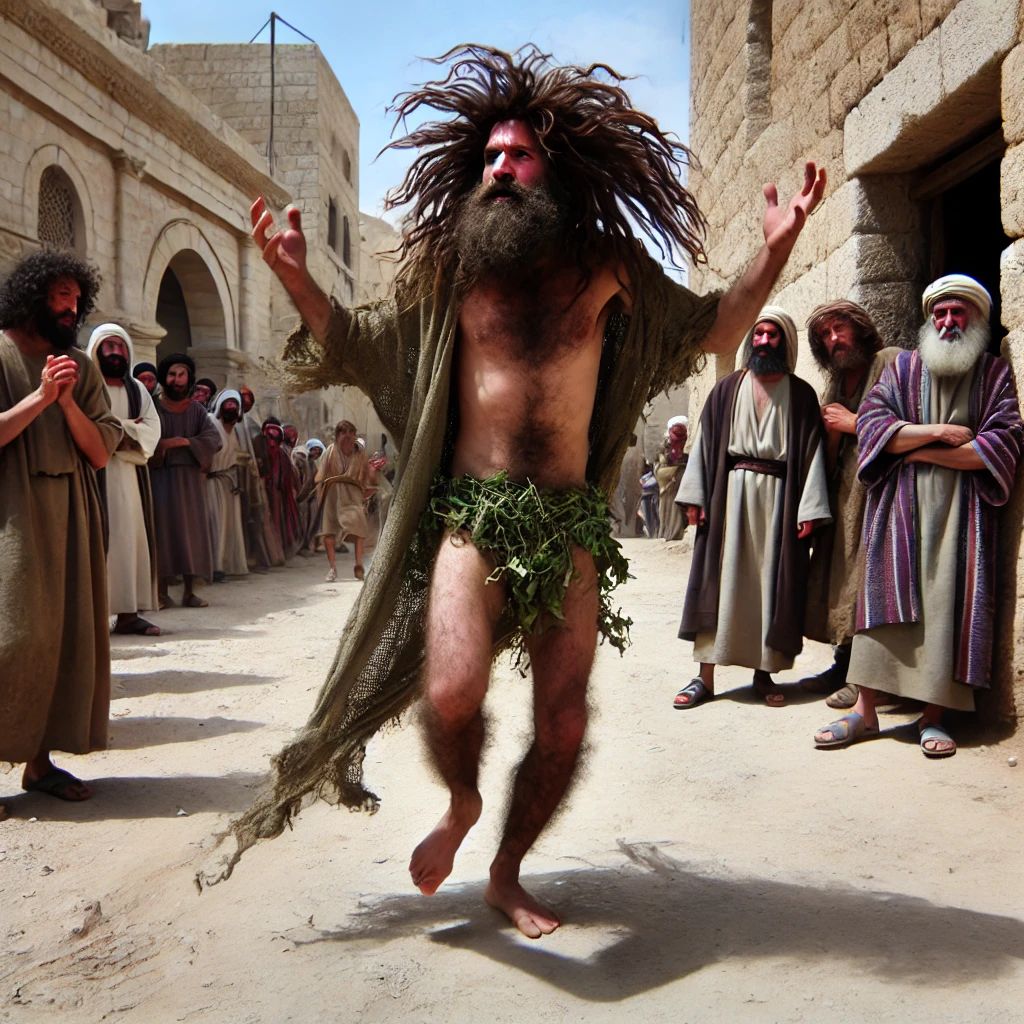
Let’s look at some of the most well-known prophets in the Bible and what they were commanded to do:
Ezekiel lay on his side for 390 days and then switched to the other side for 40 days (Ezekiel 4:4-6). He also ate food cooked over animal dung because God originally told him to cook it over human feces, and he had to beg for a more “sanitary” option (Ezekiel 4:12-15).
Isaiah walked around naked for three years because God told him to (Isaiah 20:2-3).
Jeremiah walked through town with a heavy yoke around his neck like an ox, symbolizing Israel’s submission to Babylon (Jeremiah 27:2).
Elijah called down bears to maul 42 children simply for mocking his baldness (2 Kings 2:23-24).
Saul and David had a habit of stripping naked when prophesying or praising the Lord (1 Samuel 19:23-24, 2 Samuel 6:14-22).
Micah wandered around naked and howled like a jackal in distress (Micah 1:8).
What If This Happened Today?
Now, imagine someone in modern times behaving this way. If a man lay on his side for over a year, claiming God told him to do it, we wouldn’t call him a prophet—we’d call for a psychiatric evaluation. If a preacher roamed the streets naked for three years, insisting it was a message from God, would Christians hail him as a holy man or demand he be arrested for indecency?
And yet, in the Bible, these behaviors aren’t just tolerated; they’re revered. They’re recorded as evidence of divine favor and prophetic insight.
What About the Children?
One of the most overlooked aspects of these stories is the fact that everyday people—including children—would have been witnesses to these bizarre events. Imagine living in a time where a fully grown man is wandering around town naked for three years, another man is lying in one spot for over a year cooking food over dung, and prophets are stripping off their clothes while claiming divine revelation.
Children would have seen all of this. They would have had to walk past these so-called holy men on their way to gather water or visit the market. Parents would have had to explain why their spiritual leaders were behaving in ways that today would be considered disturbing or outright dangerous.
The Hypocrisy of Christian Views on Nudity
Many modern Christians are deeply uncomfortable with nudity. They protest against sexualized images, insist on modesty, and claim that exposure to nudity is harmful, especially for children.
But where is this outrage when it comes to the Bible? Why is Isaiah walking around naked for three years completely acceptable? Why is David dancing nearly naked before God celebrated, but a woman wearing a bikini is seen as sinful? Why is it okay for prophets to strip and wander, but modern nudity is considered immoral?
If nudity is so offensive, why is it woven into the behavior of God’s chosen people? And if these behaviors were so acceptable in biblical times, why do Christians today act like the human body is something to be ashamed of?
What Does This Say About God’s Character?
If God is truly all-knowing and wise, why does he choose people who exhibit behavior we would now classify as delusional or mentally unstable? Why do his chosen messengers act in ways that today would raise serious concerns about their well-being?
If we’re being honest, the answer is unsettling. Either these individuals were genuinely experiencing divine communication, and God’s way of delivering messages is bizarre and unsettling—or they were suffering from conditions we now recognize as mental illness, and their experiences were misinterpreted as divine revelation.
What Does This Say About the People Who Wrote the Bible?
The Bible wasn’t written in real time—it was recorded by people long after the events supposedly took place. If the writers saw behavior that today we’d call psychotic episodes, hallucinations, or delusions, but instead recorded them as divine wisdom, what does that tell us about their ability to discern truth?
It also raises another question: How many other people throughout history have had similar experiences but were ignored, dismissed, or institutionalized—simply because they weren’t in the right time, place, or position of power for their words to be considered divine?
Would We Believe Them Today?
If someone today claimed to be a prophet and acted like Ezekiel, Isaiah, or Jeremiah, would we worship them? Would we write down their words and consider them sacred? Would we build entire religions around their visions?
Or would we see them for what they likely were—people in crisis, people struggling, people who needed help rather than blind devotion?
If we wouldn’t believe them today, why do we believe them just because their stories were written thousands of years ago?
Article written by Leslyann Soeung
 Logical Exodus